
NaplesHigh Water Bill
The bill jumped, but nothing looks wet
Same household, same routine, and the water bill keeps climbing with no puddle anywhere.
First check: the meter leak indicator with every fixture and the irrigation off.
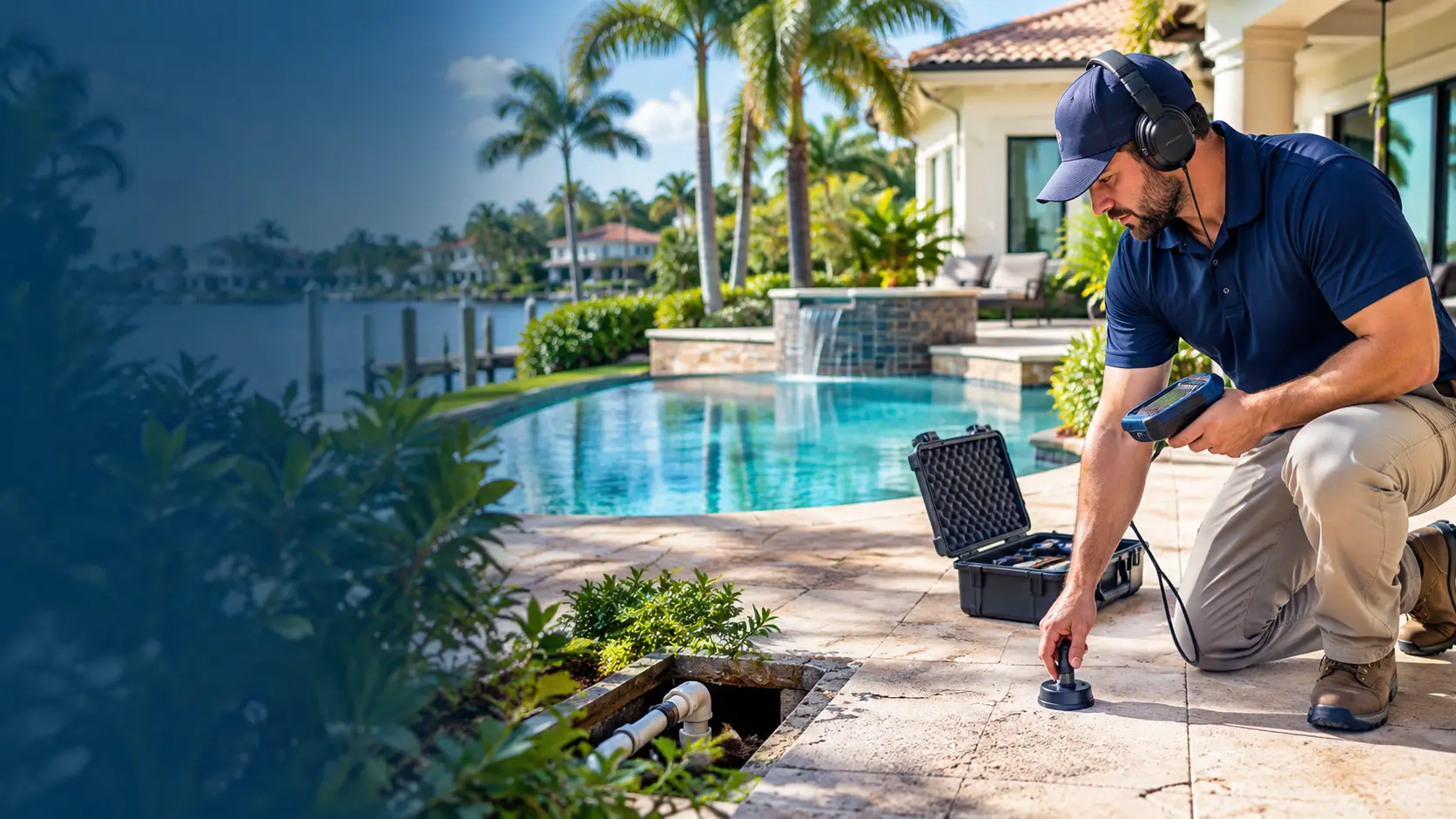
Water bill climbing for no reason? A warm patch on the tile, or water running when every faucet is off? That is how most Naples slab leaks show up. One call for leak detection Naples FL gets a licensed local tech out to find it, mark it to within inches and tell you straight what you are dealing with, before anyone touches your floor.
Leak detection is the non-invasive process of finding hidden water leaks inside walls, under concrete slabs and along buried water lines. In Naples, FL, a licensed tech confirms the leak with a meter and pressure test, narrows it down with thermal imaging, then pinpoints it with acoustic listening or tracer gas. Most homes take 1 to 3 hours.
Residential leak detection services for Naples and Collier County homes and condos. From the meter box at the curb to the pipes under your terrazzo, these are the leaks local leak detection specialists get called out for most.
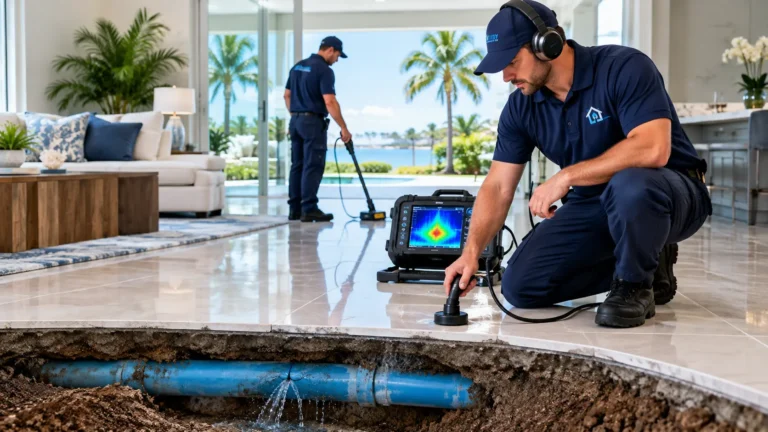
Hot and cold lines under the concrete slab, located without breaking tile.
Learn more →
Leaks inside walls, ceilings, soffits and cabinets you cannot see yet.
Learn more →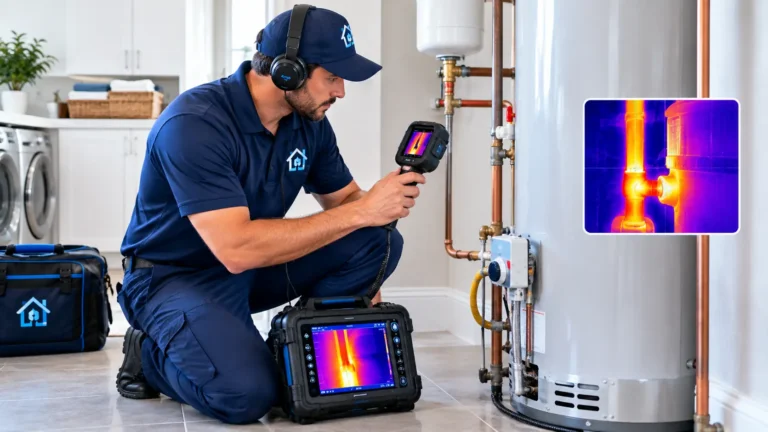
That warm spot on the floor, traced back to the exact pipe.
Learn more →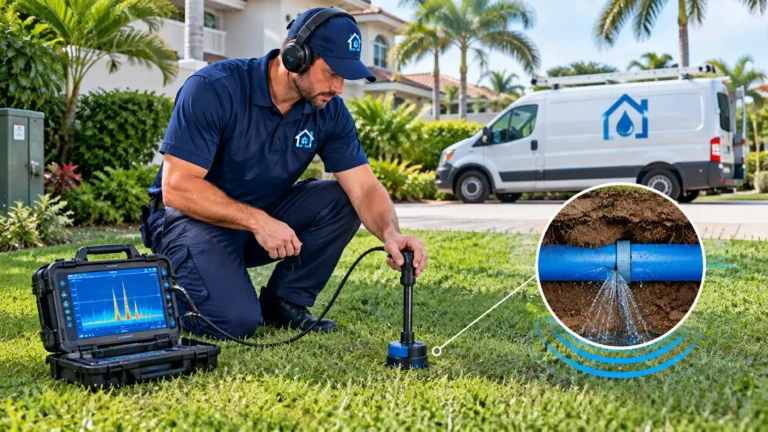
The buried service line from the meter to the house, under lawn or driveway.
Learn more →
Find where the extra gallons go: toilets, irrigation, slab or main line.
Learn more →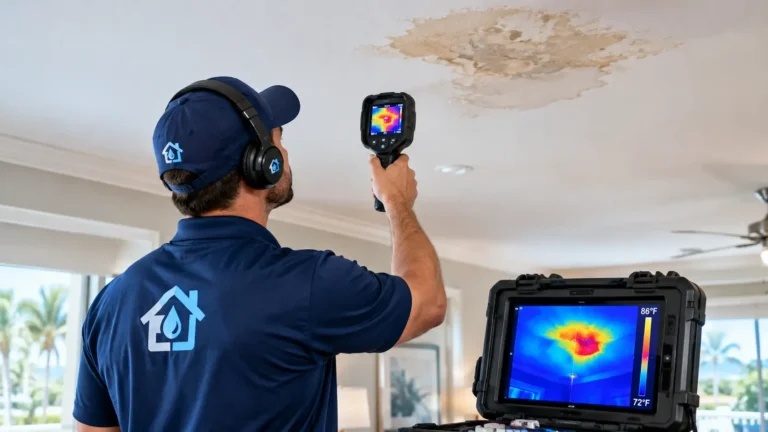
Plumbing drips through ceilings and light fixtures, including condo stacks.
Learn more →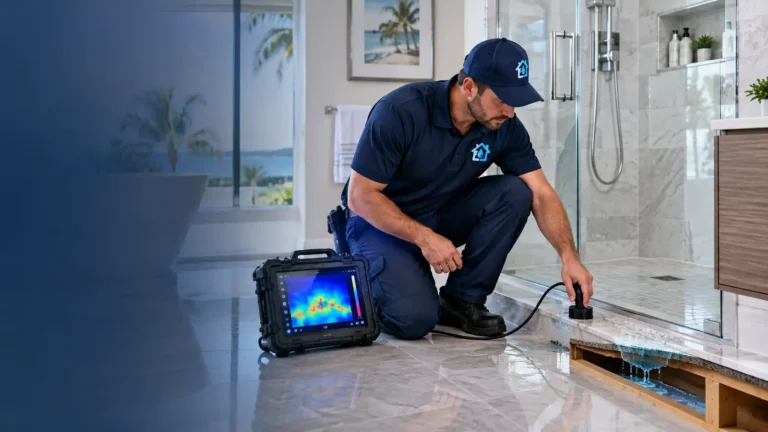
Shower pans, valves, tub drains and supply lines hiding behind tile.
Learn more →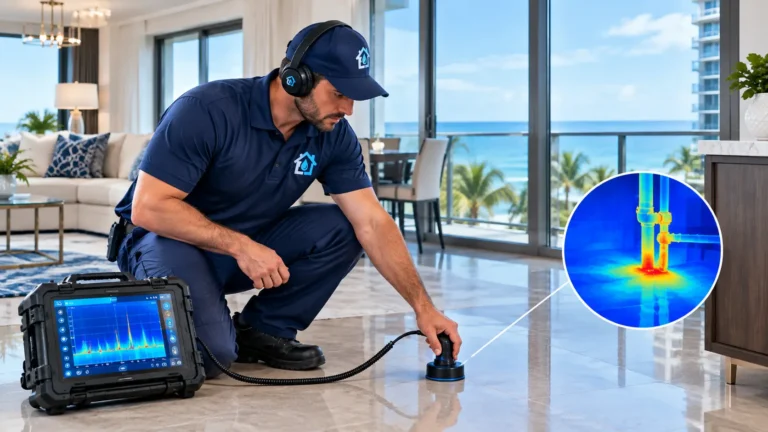
Water from the unit above or below, traced and documented for the HOA.
Learn more →The tools behind every visit, plus checks built for how Naples lives: seasonal homes, home purchases and insurance claims.
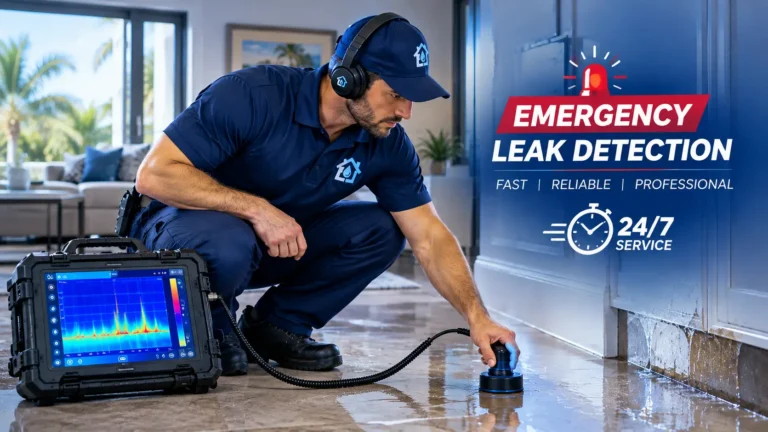
Water spreading right now. Isolate the line and find the source, any hour.
Learn more →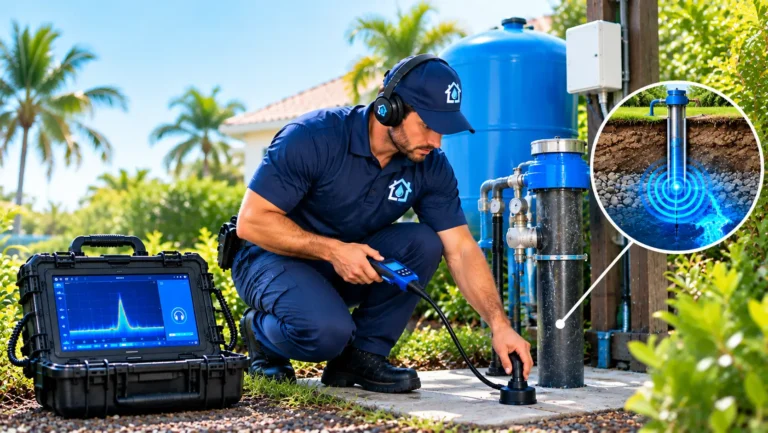
Pump cycling at night or a soggy yard on a well and pressure tank home.
Learn more →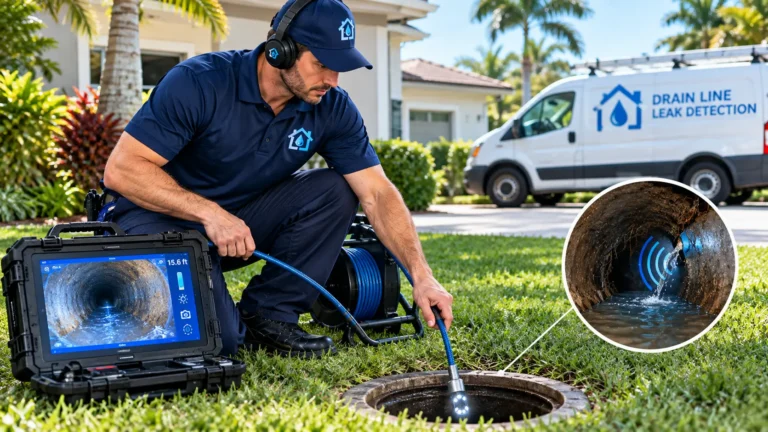
Wet floor with a still meter. A camera finds cracked drains under the slab.
Learn more →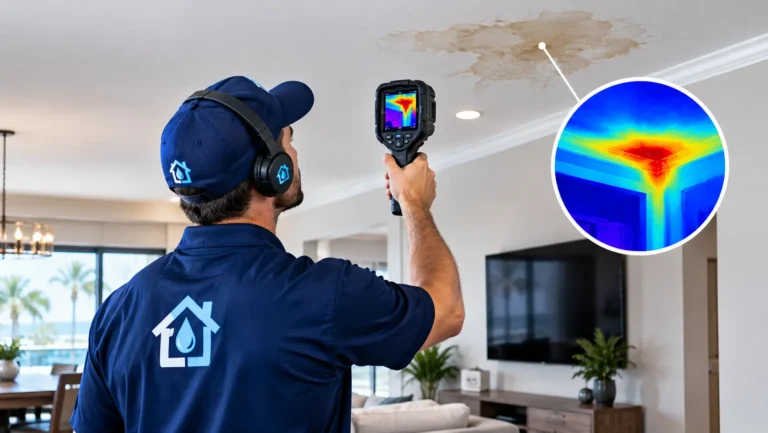
Seeing hidden water as heat and cold, before anything is opened.
Learn more →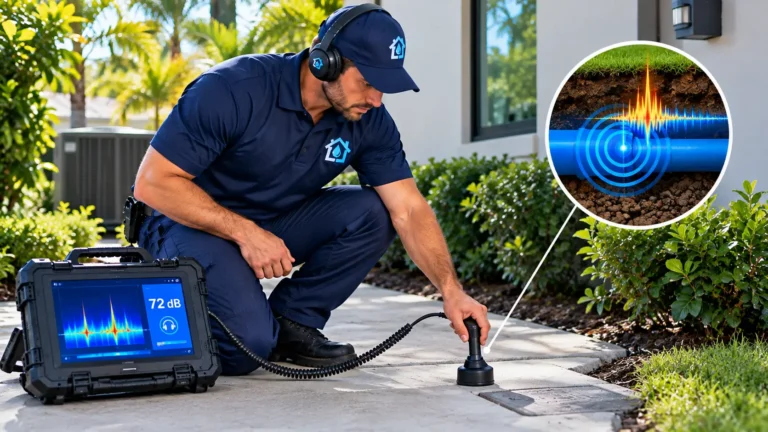
Ground microphones that hear the leak through tile, terrazzo and soil.
Learn more →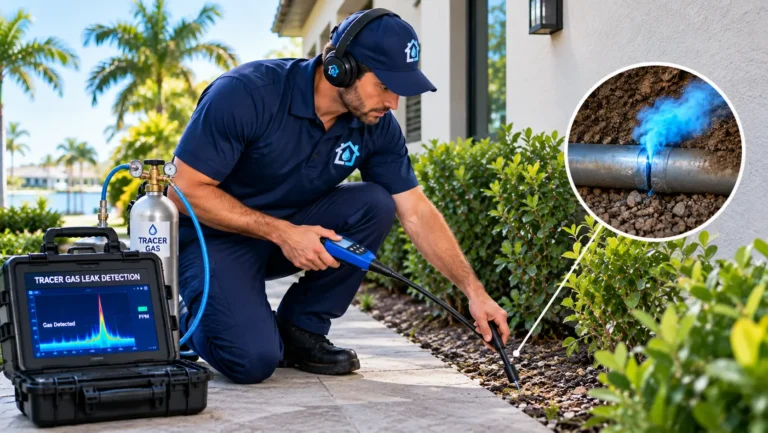
For quiet leaks in PEX, CPVC and long buried lines.
Learn more →
Before you head north, or the day you get back.
Learn more →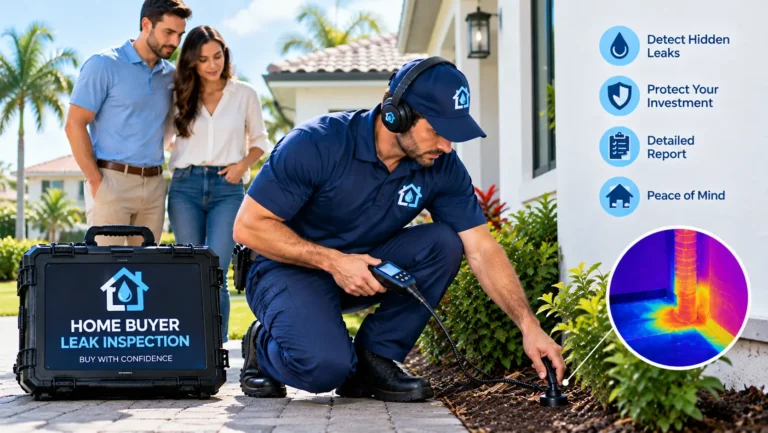
Test the plumbing during your inspection period, before you close.
Learn more →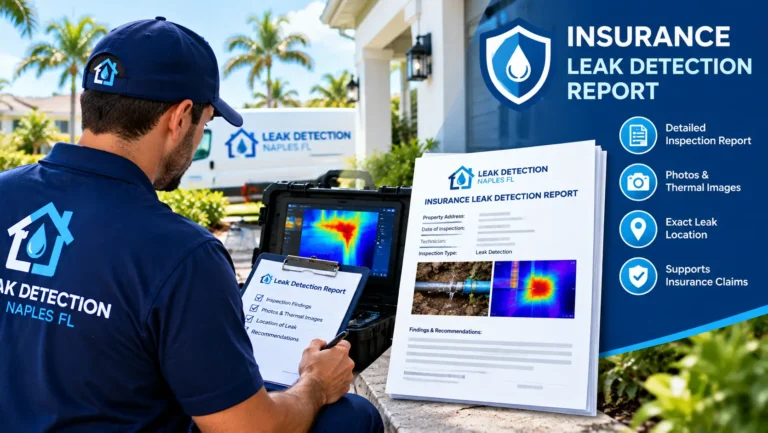
Source, photos and moisture readings for your adjuster or HOA.
Learn more →A slab leak rarely starts with a puddle. In Naples homes it usually shows up as one or more of the signs below. Tap the ones you have noticed.
1 sign checked. That is worth a professional leak check.
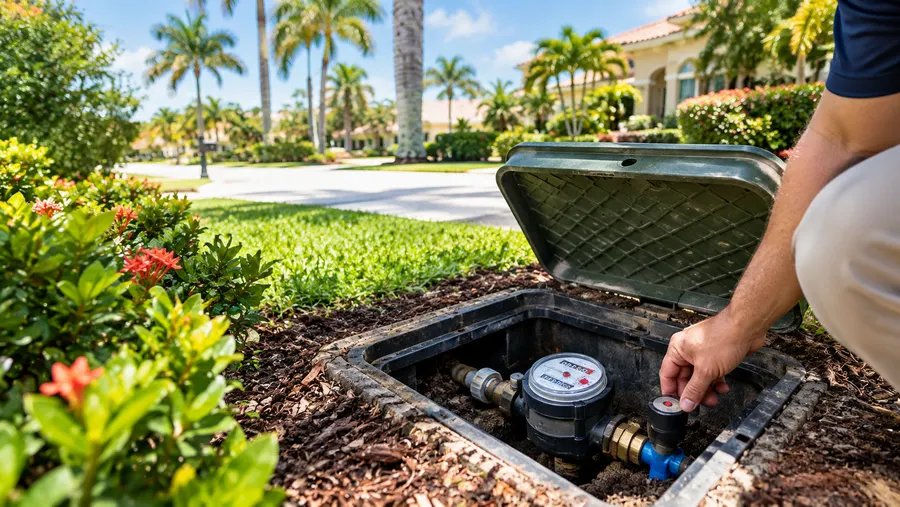
Call (239) 448-0268Most Naples homes buy water from City of Naples Utilities or the Collier County Water-Sewer District. Either way, the meter sits in a box near the street, and it is the fastest leak test you have.
Short answer: concrete slabs, sandy fill, aging copper and water chemistry. Nearly every house and low-rise condo in Naples sits on a slab with the water lines running underneath, and here is what wears them out.
Naples is built on sand over shallow limestone, and canal neighborhoods like Port Royal, Aqualane Shores and Royal Harbor sit on dredged fill. Fill settles, slabs shift a little, and the copper cast inside them does not forgive it.
Naples Park, Golden Gate City and much of East Naples went up between the 1960s and the 1980s. Copper that old pits from the inside and pinholes, and once one leak shows up, a second is often not far behind.
A hot line expands and contracts every time someone showers. Where it rubs concrete or rebar, it wears through. That is why a warm patch of tile is the classic Naples tip-off.
Collier County disinfects its water with chloramines and adds a corrosion inhibitor, while wells in Golden Gate Estates run hard and mineral heavy. Chemistry, heat and pipe age together decide how fast copper wears.
Storm surge and weeks of saturated ground move soil and strain buried service lines. Plenty of Naples leaks surfaced months after the water went down, long after the cleanup crews left.
From Pelican Bay to Lely, seasonal homes can leak from late spring to fall with nobody there. Owners usually find out from a shocking bill or a call from the HOA.
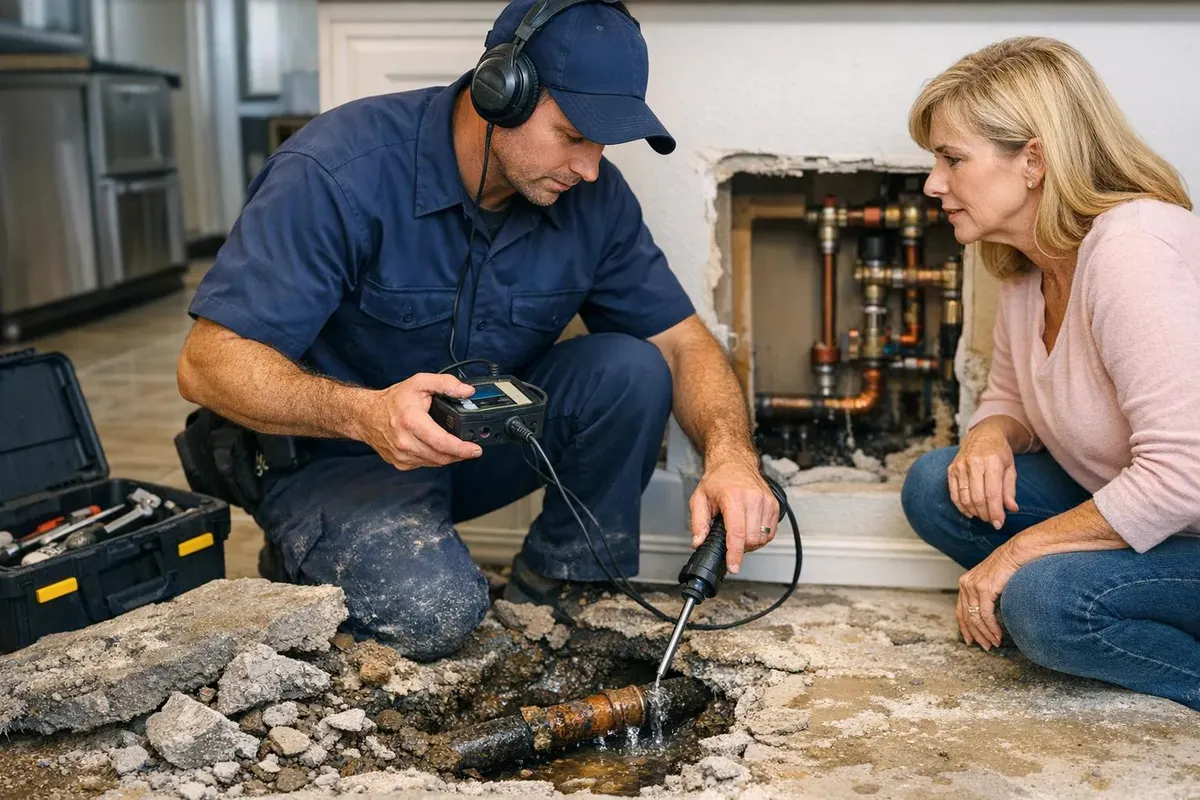
When the leak is located before any work starts, only a small section of wall or floor gets opened, right at the marked spot. That keeps the repair bill down and protects the tile, marble and cabinets Naples homes are known for.
They test, narrow and pinpoint, in that order. The goal is one small, exact mark, so if concrete ever has to be opened, the hole is the size of a shoebox, not a hallway.
Tell us what you are seeing. You get a time window and a clear idea of cost before anyone heads your way.
A meter check and a pressure isolation test show whether water is escaping, and whether it is the hot side, cold side or main line.
Thermal imaging narrows the area, then acoustic listening or tracer gas finds the break to within inches. Two methods confirm before anything is marked.
The spot is marked on the floor, and you get photos and notes for repair quotes, your HOA or your insurance adjuster.
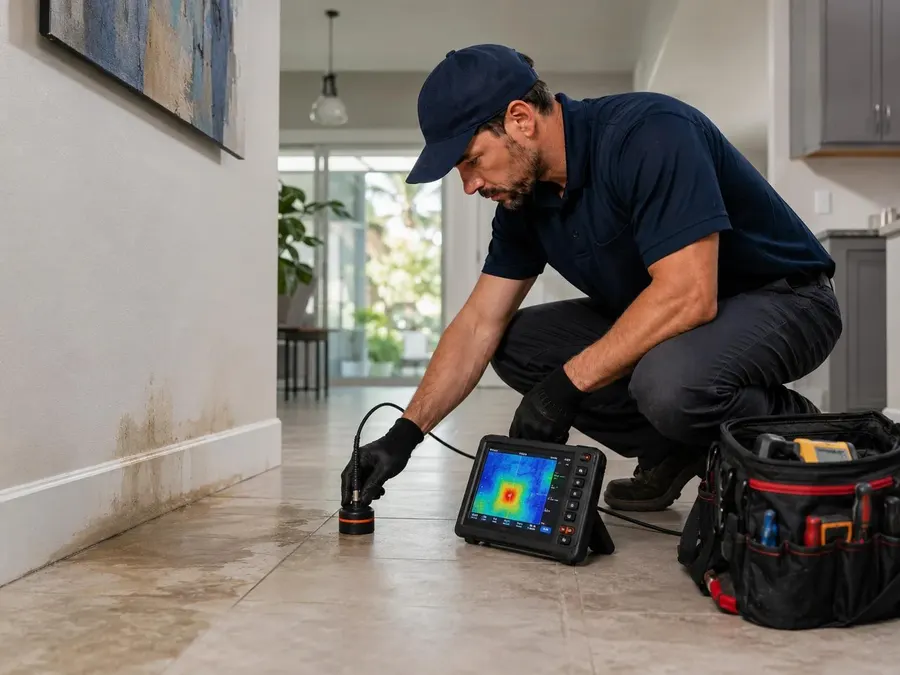
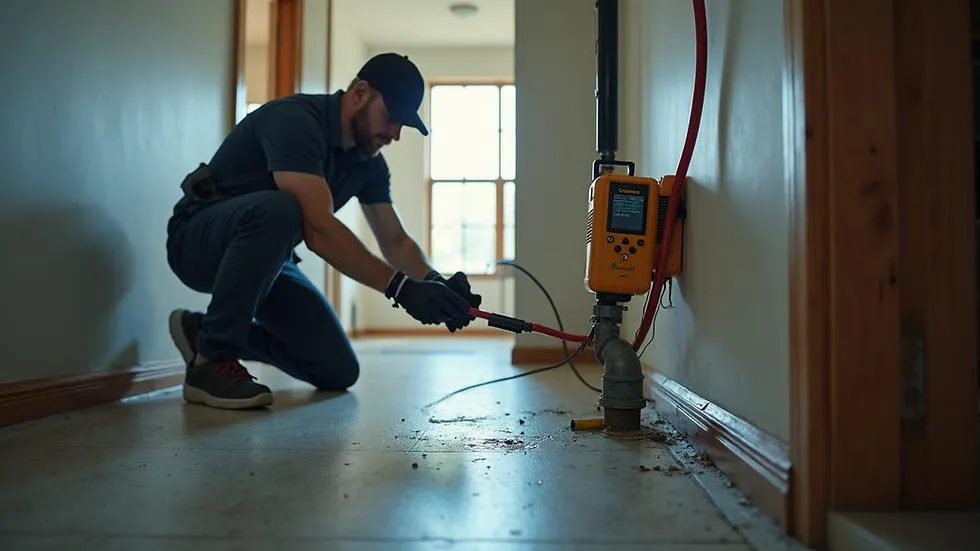
Every day it runs, it wastes water, washes sand out from under your slab and soaks into flooring and drywall. Finding it this week costs less than finding it next season.
Naples is not a typical market. Half the homes are condos or seasonal, and a lot of houses are old enough for insurers to start asking questions.
Under Florida Statute 718.111(11), the association generally insures the building as originally installed, while owners cover finishes and upgrades inside the unit. Who pays often comes down to exactly where the leak started, so get the source in writing. Common in Park Shore, The Moorings, Pelican Bay and Lely.
Heading north? Shut the main valve and switch off the water heater breaker before you go. Just back? A leak check before you unpack can catch a slow slab leak that ran all summer. Access can be set up through your property manager or a neighbor.
Florida insurers often ask for a 4-point inspection on older homes, and plumbing is one of the four. A leak test during your inspection period, especially on a 1960s to 1980s home, keeps you from inheriting somebody else's slab leak.
Many Florida policies cover sudden leaks and the cost to reach the pipe, but not the pipe itself, and some exclude leaks that ran 14 days or longer. Report quickly, take photos and keep the leak location report.
Straight answer: a basic leak check in Naples starts around $100, and pinpointing a slab leak usually runs a few hundred dollars. Most local companies do not post prices, so here is what moves the number.
| Type of check | Typical price range |
|---|---|
| Basic leak check (meter, fixtures, visible lines) | From around $100 |
| Slab leak location (pressure test + pinpoint) | Usually a few hundred dollars |
| Large homes, several lines or quiet leaks | Higher, quoted on the call |
General guidance from published Naples area pricing, not a quote. Your price depends on home size, floor type, number of lines and how hard the leak is to hear.
Five quick checks that separate a real leak detection pro from someone who just shows up with a jackhammer.
These are the situations that come up again and again across Naples, and the first thing a leak tech checks for each one.
Same household, same routine, and the water bill keeps climbing with no puddle anywhere.
First check: the meter leak indicator with every fixture and the irrigation off.
Paint bubbling low on a wall shared with a bathroom, and a musty smell that will not clear.
First check: moisture mapping and thermal imaging to see how far the water has spread.
The dog keeps lying in the same spot, and the water heater runs when nobody is using hot water.
First check: closing the water heater's cold inlet to see if the meter stops.
Signs point to a line under the slab, but the floor is stone that is hard to match.
First check: pressure testing each line, then acoustic listening to mark the spot to within inches.
Ground between the well and the house stays wet in the dry season, and the pump cycles at night.
First check: the pressure tank test with the house valve closed to split yard from house.
A ceiling stain spreading in a tower unit while the neighbor upstairs is up north for the season.
First check: building management for access, then moisture readings in both units.
The stain gets darker after someone showers upstairs, and it is growing on dry days too.
First check: running the fixtures above one at a time while watching the ceiling below.
The baseboard in the closet behind the shower is starting to swell in an older villa.
First check: a flood test on the shower pan and a pressure test on the valve.
Illustrative examples of common calls in Naples, not customer reviews.
From the beach streets off Gulf Shore Boulevard to the wells of Golden Gate Estates. Every part of Naples has its own leak story.
34102: historic cottages, canal homes and terrazzo floors.
Learn more →34103: Gulf towers, Moorings canal homes and Coquina Sands.
Learn more →34108: condo towers, coach homes and seasonal owners.
Learn more →34108: the 1951 grid, original block homes and new rebuilds.
Learn more →34110: Imperial Golf Estates and 1980s golf homes.
Learn more →34109 and 34119: gated golf and lake communities.
Learn more →34105 and 34108: estate lots, wells and club homes.
Learn more →34116: older block homes, duplexes and rentals.
Learn more →34117 and 34120: private wells, septic and acreage.
Learn more →34104 and 34112: bayfront homes, villas and lake neighborhoods.
Learn more →34113: Lely golf communities and Isles of Capri canal homes.
Learn more →34114: gated villages and seasonal owners.
Learn more →PO Box ZIPs 34101 and 34106 are also part of our Naples service list.
Check for yourself first. These guides walk through the same steps a leak tech starts with.
The 10 minute test on a City of Naples or Collier County meter.
Learn more →Nine clues Naples homeowners notice first, and how to check each one.
Learn more →Seven reasons Florida slabs leak, from old copper to settling fill.
Learn more →The most common signs are a warm spot on a tile floor, a water bill that jumps with no change in use, the sound of running water with every fixture off, a meter that keeps moving, damp carpet or loose tile, and a musty smell near baseboards. One sign is enough to get it checked.
Across the country, worn toilet flappers, dripping faucets and leaky valves top the list. In Naples, add two local regulars: pinhole leaks in aging copper under the slab, and AC condensate lines that clog in the humidity and overflow into walls and ceilings.
Work from big to small. First, run the meter test with everything off. Next, close the cold water valve on top of the water heater; if the meter stops, the leak is on the hot side. Shut toilet and irrigation valves to rule them out. A pro then narrows the spot with thermal imaging and pinpoints it with acoustic listening.
A pressure test to prove the leak exists, followed by acoustic listening to pinpoint it, is the most accurate combination for pressurized water lines. On PEX, CPVC or very quiet leaks, tracer gas is often more precise. Good techs confirm the spot with two methods before anything is marked.
Leak detection pros carry pressure gauges to isolate lines, thermal imaging cameras, electronic acoustic listening devices with ground microphones, tracer gas detectors, moisture meters and video cameras for drain and sewer lines. The kit matters, because it is the difference between a small marked spot and a torn up floor.
For homeowners, the best free tool is the leak indicator on your water meter. Battery leak sensors under sinks and water heaters, and smart shutoff valves that watch flow around the clock, are popular with Naples snowbirds. To find a leak under a slab, you still need professional acoustic, thermal or tracer gas equipment.
Yes. Licensed plumbers do leak detection, and some focus on it full time with dedicated equipment. In Florida, the repair itself should be done by a contractor holding a CFC plumbing license, which you can verify for free on the Florida DBPR website.
No. Leak detection is non-invasive. Techs use pressure isolation, thermal imaging, acoustic listening and, when needed, tracer gas to pinpoint the leak to within inches. Concrete is only opened at repair time, and only at the marked spot.
Most Naples homes take about 1 to 3 hours. Larger homes, more than one leak, or quiet leaks on PEX or CPVC can take longer.
A slab leak can run for weeks or even months before anyone sees water, because it drains into the sand under the house. In Naples, seasonal homes are the classic case: a leak starts after the owners head north and nobody notices until the next bill or the HOA calls.
A basic leak check in Naples starts around $100, and pinpointing a slab leak usually runs a few hundred dollars. National guides put most standard jobs around $175 to $350, with complex cases higher. Detection and repair are priced separately, and some companies credit the detection fee if you hire them for the repair, so ask on the call.
Usually, yes. Paying a few hundred dollars to pinpoint a leak beats paying to break open the wrong section of tile or terrazzo. You also get a written report that helps with insurance claims, HOA disputes and comparing repair quotes. For a dripping faucet you can see, you do not need one.
Start with the usual suspects: a running toilet, an irrigation zone stuck on during the dry season (roughly November to May, when sprinklers work hardest), or a house that just went from empty to full for the season. If the meter moves with everything off, it is a leak, often under the slab.
Over time, yes. Water running under a slab can wash out the sand beneath it, and moisture wicks up into flooring and drywall. Most slab leaks are caught well before structural damage, which is exactly why finding it early matters.
It depends on your policy. Many Florida policies cover sudden and accidental leaks and often the cost to access the pipe, but not the pipe itself or slow seepage. A written leak location report with photos helps when you file. Check with your insurer or agent.
A leak detection pro can trace water between units and give you a written report to share with your HOA, property manager and insurer. Under Florida Statute 718, who pays depends on where the leak started and what your condo documents say.
Yes. With no utility meter, techs pressure test the lines and watch how often the well pump cycles with everything off. Thermal and acoustic tools work the same on well systems as on city water.
No. A good leak report marks the exact spot so any licensed plumber can quote the repair, whether that is a spot repair, a reroute through the walls or attic, or a whole home repipe.
Call (239) 448-0268 and you are connected with an independent, licensed leak detection specialist who works in Naples. Before work starts, check their license on the Florida DBPR site and ask what equipment they use. A real specialist will mention a meter or pressure test, thermal imaging and acoustic listening, not just a guess at where to dig.
A typical residential visit in Naples starts with a meter test to confirm the leak, then pressure tests to find which line is losing water. Thermal imaging narrows the area, and acoustic listening or tracer gas pinpoints it, so only one small spot is marked. You should get photos and notes you can use for repair quotes and insurance.
Not always. A water leak detection company specializes in finding hidden leaks with equipment such as thermal cameras, ground microphones and tracer gas. A plumber makes the repair. Some plumbers do both, but many homeowners have the leak found first, then get repair quotes for the exact spot.
Leak detection is available across the Naples side of Collier County: every ZIP code from 34102 to 34120, including Old Naples, Park Shore, North Naples, Golden Gate City, Golden Gate Estates, East Naples, Lely and Fiddler's Creek. Marco Island, Immokalee and Ave Maria are outside the current service list.
All of Naples, FL: ZIP codes 34102, 34103, 34104, 34105, 34108, 34109, 34110, 34112, 34113, 34114, 34116, 34117, 34119 and 34120, from Old Naples and Park Shore to Golden Gate Estates and Fiddler's Creek.
This page was put together for Naples homeowners from local utility data, Florida law and how leak detection is actually done in Collier County homes. Prices are general ranges, not quotes, and nothing here is legal or insurance advice. Sources we lean on:
One call gets a Naples leak detection pro on the way to find it, mark it and walk you through your options in plain English.
Call Now: (239) 448-0268